
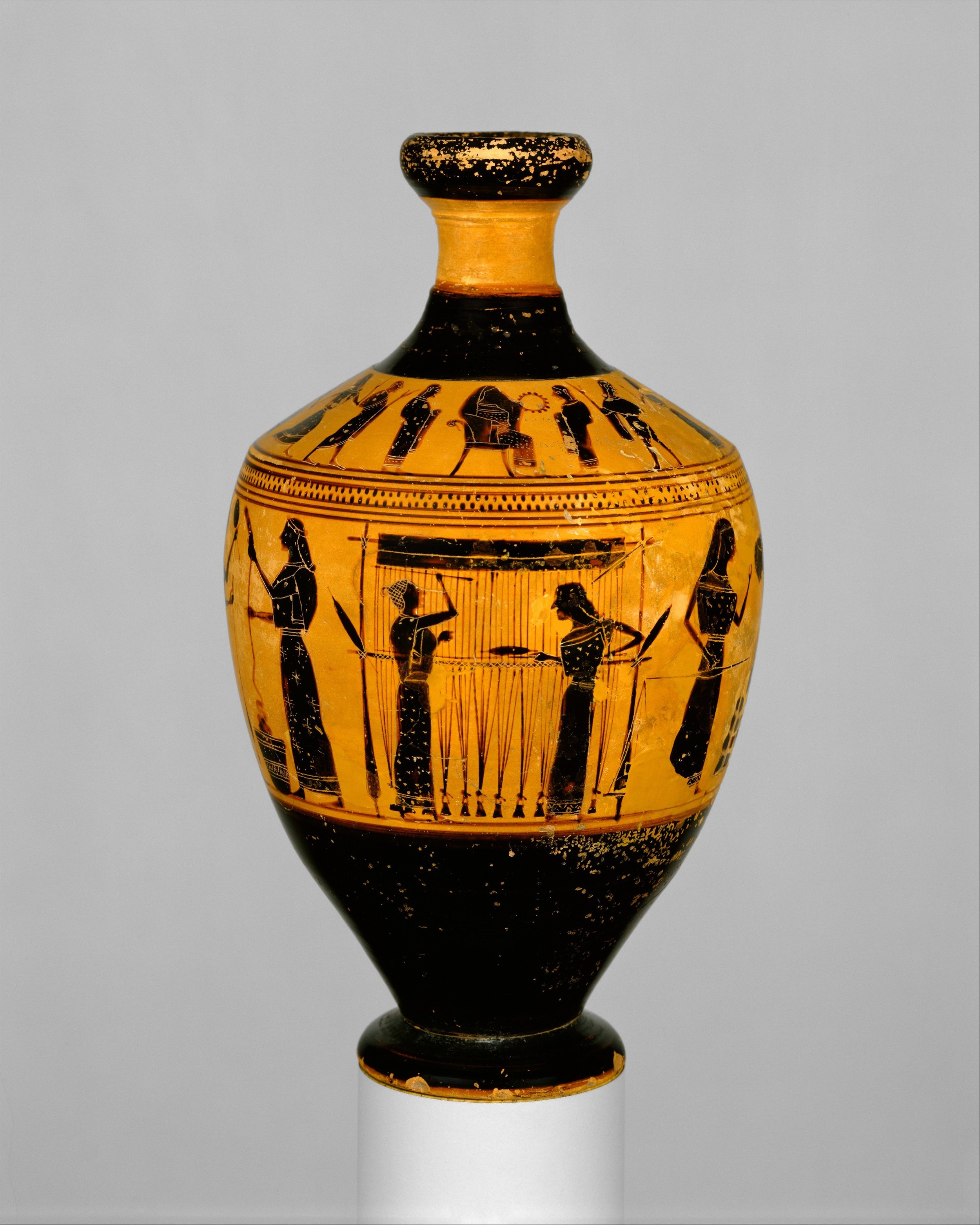
This is the third and final installment of this essay. In Part I discuss the astrological signatures of our current time that this essay is exploring, as well as the main archetypal themes.
Aries symbolizes the vitalizing energies of life emerging from the fallow ground of winter. In psychological terms, it is the zodiac sign associated with individualism, autonomy and the freedom to go in search for and express the fresh, new energies that are emergent.
Neptune in Aries reflects the collective stirring and longing for new beginnings and radical changes from the past. Archetypal figures that personify these values include the crusader who is fired by a vision, a sense of mission and has faith in their conviction and the pioneer who pushes into the unknown to discover a new world. Both are Aries figures who shine a light on the courage, passion and belief in possibilities of Neptune in the cardinal fire sign. These visions can stir creative actions and lead to the birth of ingenious, fresh things.
But there is a shadow side—suffused with faith in our convictions, and blazing new paths forward, we can become blind to limits, or ride over another’s needs or point of view caught up as we may be in the fiery vision of what we see as right action.
Autonomy, that sense that no-one who has any power over me, that I are free to be who I am and act in accordance with my desire, this like all principles, has its own dark shadow—inflation of self, which the Greeks called hubris.
I want to look more closely at these two Neptunian and Aries themes—ingenuity and inflation—through the myth of Arachne and Athena.
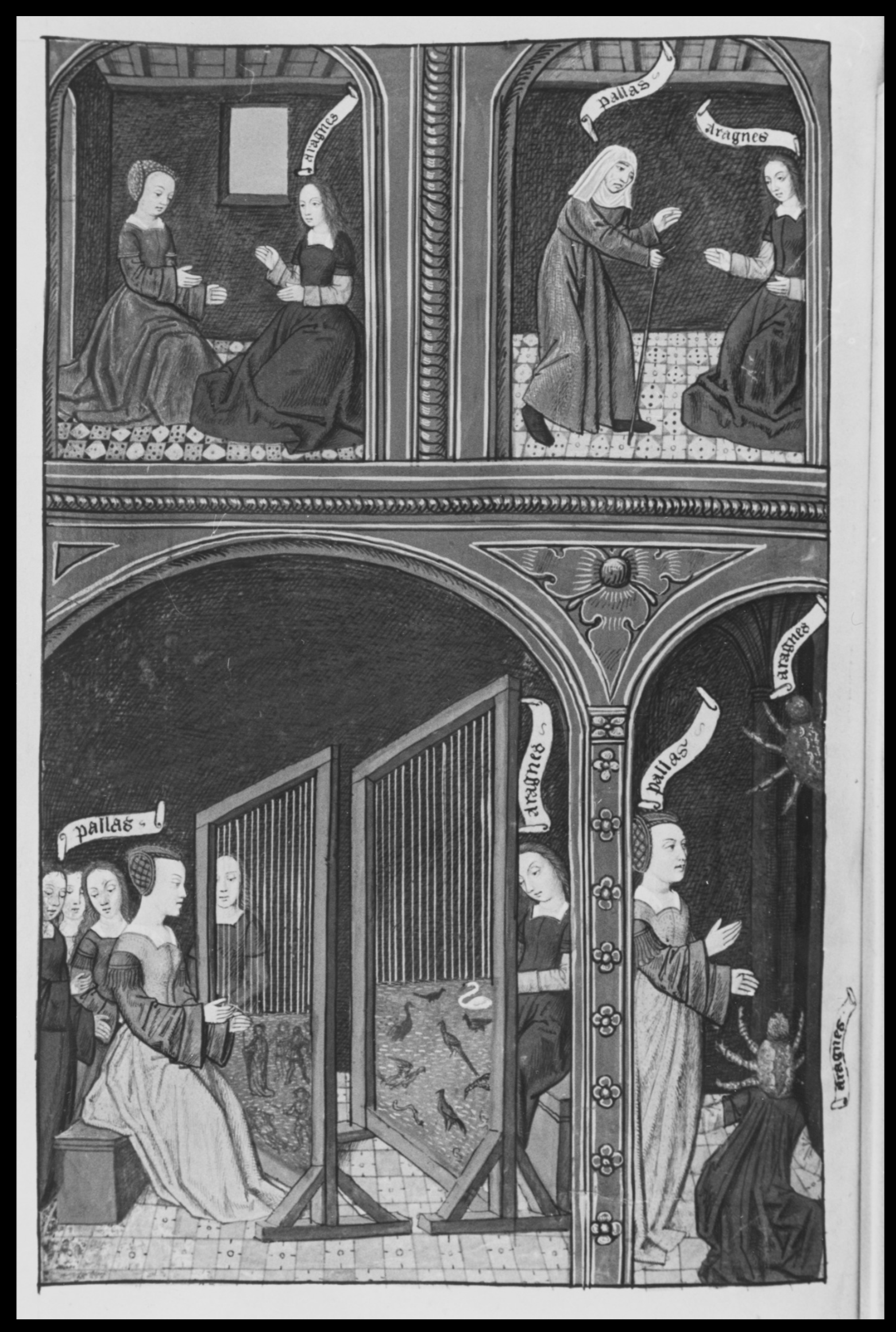
Flemish illuminated manuscript painting of Arachne and Athena
Arachne was an extraordinarily gifted weaver. It was said that her work was so exquisite that nymphs would leave their woods and waterways to gaze upon her as she worked. Listen to the Roman poet Ovid’s description:
“One could delight not only in her finished work but find enchantment as her art unfolded: whether she gathered the rough wool in a new ball, or worked it with her fingers, reaching back—with gestures long and apt—to the distaff for more wool she could draw out, thread by thread—wool that was like a fleecy cloud—or twisted her agile thumb around the graceful spindle, and then embroidered with a slender needle, one knew that she was surely Athena’s pupil.”[1]
It is not the finished work that enchants but Arachne’s skill as a weaver—the irresistible elegance and dexterity that draws spectators. This is the sparkling genius of Aries, demonstrating its prowess in its craft, delighting in the display of its ability through its actions.
Now comes the trouble. Though everyone knows Arachne is the gifted student of Athena, Arachne denies it. Whenever she was praised as such, Arachne would kick back. Ovid, “Instead of taking pride in following so fine a mentor, she’d reply, as if offended: ’Let Athena contend with me; and if I lose, whatever she demands of me, I’ll do.’” Arachne suffers from the all too human problem of hubris. In astrological language, this can be an Aries problem—and emphasis on our subjective individual experience—me, what I can do and what I want.
To be inflated like Arachne is to claim one’s talents are a result of our human ingenuity and skill, rather than as a gift from the gods. When held as a gift from the gods, we shepherd and cultivate a talent, aware that its source is much greater and more significant than us, even while needing to be expressed in the world through us.
This is poignantly expressed in the way Athena comes to Arachne and counsels her to desist from her hubris, the egoic attitude that claims her genius as her own. The goddess does this by taking on the guise of an old woman and saying to Arachne, “Take my advice; it is enough to be supreme among all mortals when you weave and work your wool, but never do compete with an immortal goddess. Go, beseech Athena’s pardon for the words you spoke; ask humbly and she will forgive your boast.”
Athena is asking Arachne to recognize that she has been blessed and to acknowledge the blessing not as some humiliating subservience but as right relation between the transpersonal source of her genius and her bringing it out into life, thereby reinstating the right relation between the above and the below.
Neptune in Aries symbolizes the stirring of the ideal of individual potency, which can be the very source of ingenuity. Arachne helps us recognize the inflationary danger of that vision. I see Athena here, in her guise as an old woman counseling Arachne to ask for Athena’s forgiveness and to remember that her gift comes from the goddess as a bit of Saturn in Aries wisdom. First, there is a delightful appearance of Saturn in Athena’s old woman disguise (Saturn is the old one). More deeply—Athena is attempting to remind Arachne of her mortal limits and the true origin of her gift. Saturn represents the archetypal principle of limitation, so where the excesses of Neptune in Aries can soar, Saturn brings about the necessary grounding.
In her discussion of Neptune/Saturn, Erin Sullivan writes, “every contact that Saturn makes to Neptune offers insight into a particle of our deepest spiritual centre.”[2] Athena is attempting to wake Arachne up—Saturn is the reality principle—to the fantasy that her genius is born out from herself alone (Aries) and damn anyone who says otherwise. Here we can return to the polarity of Libra and its values of right relationship and cohesion, symbolized by weaving (see Part II). Athena’s medicine is her craft of weaving—the connection of the divine to the human, the above to the below—but the irony is Arachne doesn’t see it blinded as she is by the Aries ME.
Back to the drama: Instead of listening to this sage advice, Arachne scowls in her rage and insults the old woman. Athena throws off her disguise and while the nymphs bow down before her, Arachne shows neither awe nor respect for the goddess.
So be it— the weaving competition begins. Athena creates scenes depicting the gods in their glory and in the four corners she shows those mortals who transgressed the gods because of their hubris. She is trying to warn Arachne yet again. The gods, it seems, do tolerate a certain amount of inflation and pride, but it is the excessive and prolonged identity with this attitude that goes against the cosmic order.
At the same time Arachne weaves as if filled with the spirit of Aries, the golden ram aggressively charging forward with head down. This is evidenced in her willful and testy choice of subject—scenes of the gods in their violent and lustful seductions of humans.
Once their weaving is done, the competition is over, Athena and Jealousy regard Arachne’s work, which is flawless. But the audacity of her attitude combined with her irreverent depiction of the gods infuriates Athena and she strikes Arachne on the forehead with a shuttle. In medical astrology, the head is associated with Aries. Overwhelmed by the insult, Arachne tries to hang herself, but Athena intervenes and transforms her into a spider. Arachne lives her days weaving her web.
We live in the Age of Arachne. The privileging of ego consciousness over all the other kinds of intelligence—the body, the heart, the emotions. This is evident also in the valorization of the driving, striving, glory seeking, productive ego, and how we believe that our inventiveness is no longer hindered by the gods of previous ages. But as C.G. Jung as shown, this is a grave error. “All ages before us have believed in gods in some form or other. Only an unparalleled impoverishment of symbolism could enable us to rediscover the gods as psychic factors, that is, as archetypes of the unconscious.”[3]
Jung’s move to treat the gods as archetypes translates into psychology as the need for reverence, awe and lack of hubris. As Jung saw it, hubris was a chronic or excessive form of inflation which came about by being unconscious of archetypes, by not recognizing the transpersonal dimension of the psyche enough. We could say his whole psychology is an attempt to address the Arachne problem. Neptune’s ingress into Aries suggests that the Arachne problem may come to the foreground in a new way, which means an opportunity to cultivate our own right relationships to the gods who have claimed us.
There’s one more thread I want to add to the larger fabric of this essay—the Neptune/Saturn conjunctions are within a 10 orb from February 2025 through February 2027 which portends meetings between the finite realm, the mundane realm of our daily lives (Saturn) with the transcendent and subtle dimension (Neptune). Saturn wants to weave into existence something of the timeless cosmic beauty of Neptune’s vision.
The heavenly aspect of weaving is beautifully expressed in the Iliad—the Trojan queen brings a robe to Athena’s temple which is said to “shine like a star.”[4] Weaving is related to something divine. From a psychological point of view, it points to an archetypal process, something elemental to both the imagination and life.
René Guénon’s study on the symbolism of weaving in The Symbolism of the Cross deepens the cosmic dimensions of the metaphor. On the loom, the warp refers to the vertical threads that are formed and create the foundation of the weave. The weft (or woof) are the horizontal threads made by the shuttle passing through the warp.
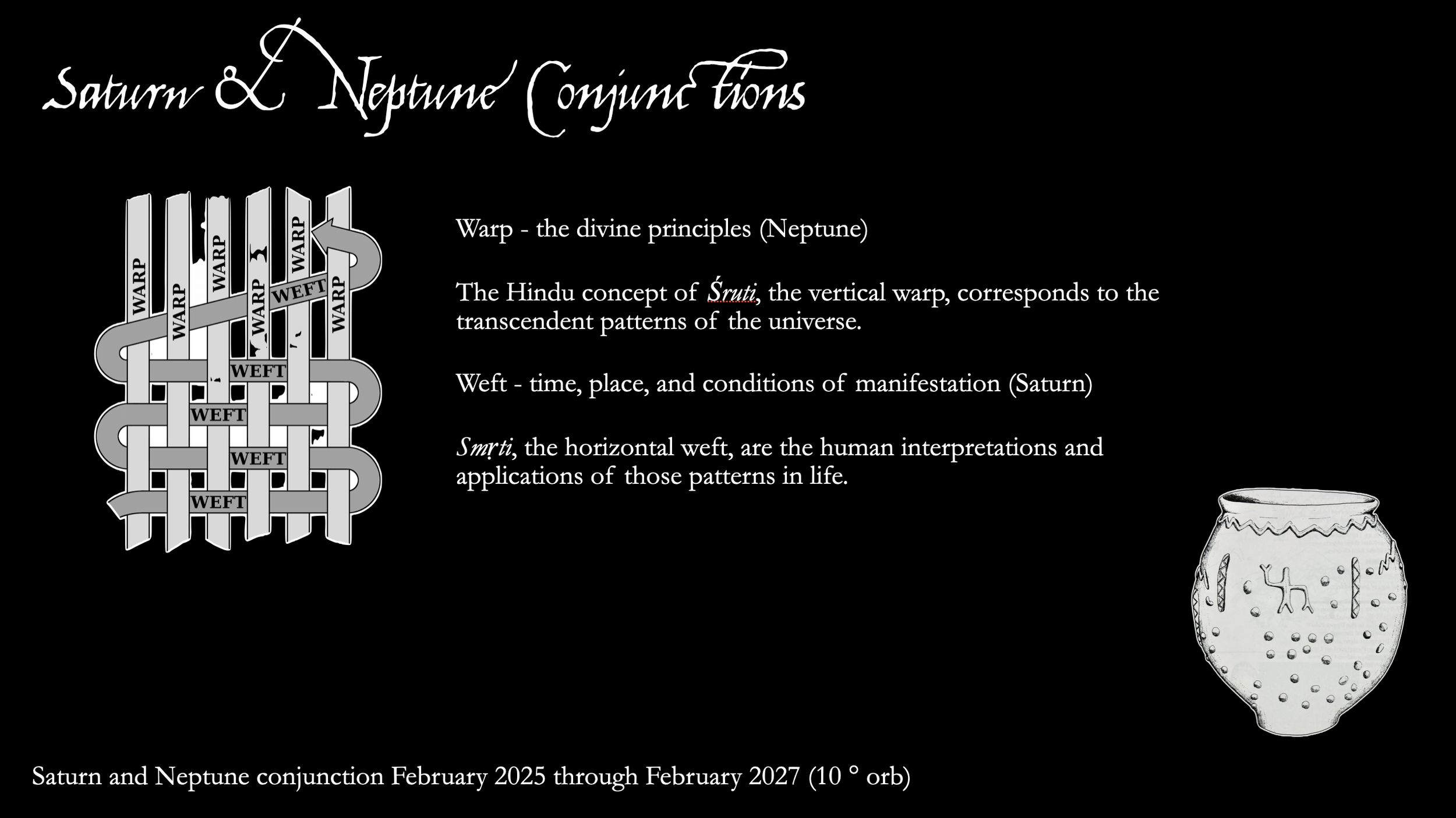
In cosmic terms, the warp corresponds to the divine principles of the world and the weft is the time, place and conditions in which those principles manifest. The Hindu concept of Śruti, the vertical warp, corresponds to the transcendent patterns of the universe. Smṛti, the horizontal weft, is the human interpretations and applications of those patterns in life. Together these threads weave the world as a garment of divinity.
In another beautiful metaphor, Śruti is compared to the light of the Sun and Smṛti to the light of the Moon, the two luminaries symbolizing not only the eternal and temporal but also masculine and feminine energies in the universe.
Let’s imagine Saturn’s conjunctions with Neptune are an expression of this weaving work, where the transcendent images and ideals of the archetypal realm (Neptune) are brought into life and cultivated through our dedicated work of consciousness (Saturn), of taking the imagination (Neptune) seriously (Saturn). The Aries signature points to the specific problem and collisions of the individual, the longing for freedom and autonomy and how that responds to the Libran dimension of the psyche (see part II).
Personifying that Libran quality of consciousness, Athena’s gift of weaving is thus a way of conceiving our overall relationship to the gods. By attending to Athena, this one god, we are in a sense attending to the many gods.
The quality of these relationships, when imagined from within Athena, is characterized by the values of cohesion, community, mediation, peacefulness, right order and justice. We might also say that a desire or yearning for peace, cohesion, protective enclosure is where Athena is at work in us, present in our consciousness. This is Athena’s Libra medicine to the potential challenges of Neptune in Aries.
How we are called to recognize the weave of our lives (the woof) upon the principles/archetypal patterns or threads (the warp) of the gods? Athena’s presence in our lives is here when we are working at the loom—discerning how our work and engagement with community are entwined with the deeper patterns of nature.
At the heart of this is the attempt to find the cohesive vessels for the fracturing and conflicting problems of life. This is what Saturn processes are dedicated to building. This involves learning to be agile with the spindle upon which the raw materials of life are wound, and which we try to work into a finer form. And perhaps we can conceive of that as Neptune and Saturn in Aries opportunities--becoming more attuned to and deft with working the raw into finer form. That would be the ingenuity of Aries and Libra in a dynamic syncopation.
In our Athena work of weaving vessels, we are working at the loom of consciousness, working at the purposeful joining of our lives in relationship to the divinities that are embedded within it, that form the warp. And that fabric is cosmic, it participates in kosmos, the beautiful, right order of things.
This new cosmic chapter, filled with so many fresh potentialities also calls for us to work at being able to separate, to discriminate both mentally and emotionally the Neptunian longings and find appropriate Athena tempered vessels for their Saturn manifestation. It is a weaving of the above with the below, in order for there to be a greater cohesion between these realms and our lives.
References
[1] Ovid, The Metamorphoses, trans. Mandelbaum (Mariner Books Classics, 1995), Book 6
[2] Erin Sullivan, Saturn in Transit: Boundaries of Mind, Body, and Soul (Samuel Weiser, 2000), p. 311
[3] C.G. Jung, The Archetypes of the Collective Unconscious Collected Works v.9i (Princeton University Press, 1934/1981), para 50
[4] The Iliad, quoted in John Scheid and Jesper Svenbro, The Craft of Zeus: Myths of Weaving and Fabric (Harvard University Press, 2001) p.17